

We are excited to share this with our supporters and Thralled that our line keeps growing
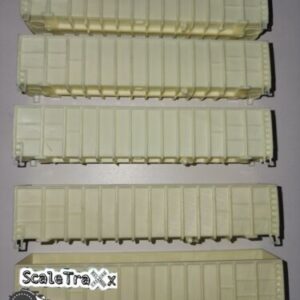
We like to present another brand new unique car to our line in both N and HO.
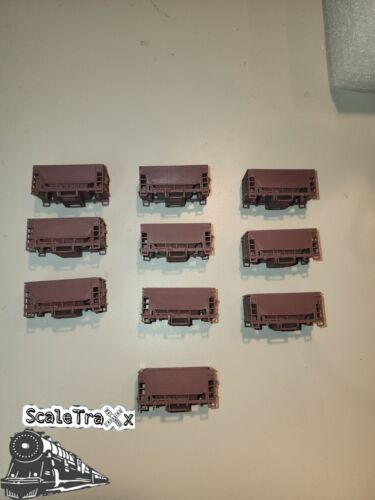
Each model will come with detail parts, brass stirrups and there unique trucks.
THIS FOR 3 CARS
Colors will vary from the stock.
BODY MOUNT COUPLERS AND WHEELS NOT INCLUDED
So let’s give you some history
Kansas City Southern’s 75-Foot Thrall 150-Ton Gondolas:
The Evolution of the “Rail Whales”
During the height of American coal railroading in the late 1960s and early 1970s, railroads were constantly searching for ways to move more tonnage with fewer cars, fewer crews, and greater efficiency.
Unit trains were becoming the future of bulk transportation, and coal carriers were experimenting with larger, stronger, and more specialized freight equipment.
One of the most ambitious experiments of this era came from the Kansas City Southern Railway (KCS) and the Thrall Car Manufacturing Company. In 1970, Thrall constructed a unique fleet of enormous 75-foot, 150-ton rotary-dump gondolas specifically for KCS.
These cars were unlike anything else operating on American rails. Their unusual length, massive capacity, and heavy-duty construction earned them the nickname “Rail Whales” among railroad enthusiasts because of their enormous size and unmistakable appearance.
Only a small fleet was produced, making these cars one of the rarest and most fascinating freight car designs in North American railroad history.
The Birth of the Giant Gondola
When Kansas City Southern placed its order with Thrall in 1970, the goal was simple: create a coal car capable of carrying substantially more material than conventional gondolas.
Most coal cars of the period were considerably shorter and lighter, but KCS wanted a car optimized for dedicated rotary-dump coal service. The result was a massive high-capacity gondola measuring approximately 75 feet 11 inches long, nearly 20 feet longer than many standard coal cars of the era.
The cars were built as a dedicated fleet of 75 units, designed to operate together in specialized coal service.
Their unusual size meant they were not intended to roam freely throughout the national rail network. Instead, they were built around a specific operating plan where the cars could remain together as a dedicated trainset.
Unlike ordinary freight cars that could easily be mixed into general freight operations, the KCS cars were a highly specialized piece of equipment designed around one purpose: moving enormous quantities of coal efficiently.
Construction and Engineering
Everything about the 75-foot Thrall gondolas was built on a larger scale.
The car bodies were constructed using heavy welded steel and incorporated a reinforced structure capable of handling extreme loads. The cars used Cor-Ten weathering steel, allowing the exterior to develop a protective rust-colored coating rather than requiring traditional painted finishes.
This gave the cars their distinctive appearance while reducing maintenance requirements in harsh coal service.
The long gondola body required extensive reinforcement to prevent twisting, bending, and fatigue. Coal is a dense commodity, and a fully loaded car placed enormous forces on every part of the structure.
The side walls were strengthened with heavy vertical bracing designed to resist the outward pressure created by thousands of pounds of shifting coal.
The end structures were also reinforced to withstand the forces generated during braking and rotary unloading.
The underframe was specially engineered for the tremendous weight of the car. A depressed-center design helped maximize capacity while keeping the center of gravity lower, improving stability during operation.
The Six-Wheel Buckeye Trucks
Perhaps the most recognizable feature of the KCS “Rail Whales” was their enormous six-wheel Buckeye trucks.
A standard freight car of the era typically used two four-wheel trucks. That arrangement was not sufficient for a car designed to carry approximately 150 tons of coal.
Instead, each KCS gondola rode on two three-axle trucks, giving the car a total of 12 wheels.
These heavy-duty trucks spread the weight over more axles, reducing the load placed on individual wheels and helping the cars safely handle their extreme gross weight.
The trucks themselves became one of the defining visual characteristics of the cars. The long wheelbase and three-axle design gave the gondolas a distinctive appearance unlike any other coal equipment operating at the time.
Model railroaders attempting to recreate the cars have noted the difficulty of reproducing the unusual truck arrangement and long wheelbase, which further demonstrates how unique the prototype was.
The Three Major Design Revisions
Although the KCS fleet was built as a specialized group, the cars underwent engineering refinement throughout their service lives. These revisions focused on strengthening the carbody, improving durability, and adapting the cars to the harsh environment of heavy coal service.
Phase 1: Original 1970 Production Design
The first version represented Thrall’s original concept.
The Phase 1 cars featured the basic structure that made the 75-foot gondolas unique:
Massive high-side gondola body
Heavy external side bracing
Long welded steel construction
Depressed-center underframe
Six-wheel Buckeye trucks
Cor-Ten steel construction
The original design was built around maximum capacity.
Every component was oversized compared with normal freight equipment because the car was expected to carry loads far beyond what conventional gondolas handled.
The side structure relied on heavy vertical supports extending from the upper chord down toward the lower sill. These braces prevented the large side sheets from bowing outward under the pressure of a full coal load.
The ends were relatively straightforward but heavily built, designed to withstand the forces of coal shifting during acceleration and braking.
Phase 2: Structural Reinforcement Improvements
As the cars accumulated service experience, additional reinforcement became necessary.
The second phase focused on strengthening areas exposed to the highest stresses.
The upper structure received improvements with a deeper and stronger top chord, increasing resistance against bending forces.
This was especially important during rotary dumping, where the entire car was lifted, rotated, and subjected to forces completely different from normal operation.
The side bracing was refined, improving the connection between the vertical posts and the lower side sill.
Additional reinforcement plates and gusset-style strengthening helped spread stress over a larger area of the carbody.
These improvements increased durability and reduced the likelihood of fatigue failures caused by years of heavy coal service.
Phase 3: Final Evolution
The final revision represented the most refined form of the KCS 75-foot gondola design.
This version combined the heavy structure of earlier cars with improved reinforcement techniques.
The deep upper chord design remained, while side reinforcement was improved to provide additional rigidity.
The lower sill structure was strengthened, creating a more continuous and durable frame capable of handling repeated loading cycles.
End construction also received attention, with stronger corrugated panels designed to better resist impacts from shifting coal.
By this stage, the cars represented the peak development of the original concept: a massive, specialized rotary-dump gondola designed around maximum capacity and heavy-duty operation.
Operating the Giant Coal Trains
A full train of these cars was an impressive sight.
With 75 cars operating together, the train carried more than 11,000 tons of coal in one movement.
The loaded train stretched well over a mile when the locomotives and other equipment were included.
Moving this much weight required multiple high-horsepower locomotives and careful handling by crews. Engineers had to manage acceleration, braking, and slack action carefully because the forces involved were far greater than those encountered with ordinary freight trains.
The cars were built specifically for rotary-dump service. Instead of unloading through doors underneath the car, the entire gondola was secured in a rotary dumper and turned upside down, allowing gravity to empty the coal.
This system allowed for extremely fast unloading and was ideal for high-volume coal operations.
The Challenges of the “Rail Whales”
While the cars were an engineering achievement, their size also created challenges.
Their massive weight placed additional demands on track infrastructure.
Their unusual dimensions limited where they could operate.
Their specialized construction meant they were difficult to use outside the specific service they were designed for.
Unlike standard coal gondolas, which could be transferred between railroads or reassigned to different commodities, the KCS cars were tied closely to their original purpose.
They represented a perfect example of a freight car optimized for one mission.
Later Years and Legacy
Eventually, changing railroad practices and the development of more flexible coal equipment reduced the need for such specialized cars.
Some of the surviving cars reportedly found secondary uses after their coal service, including service carrying bulk materials such as wood chips.
The cars’ unusual size and construction made them memorable long after their primary coal-hauling careers ended.
Today, the Kansas City Southern 75-foot Thrall gondolas remain one of the most interesting freight car experiments ever attempted.
They represented a time when railroads were willing to push engineering boundaries in pursuit of greater efficiency.
Their massive dimensions, unique six-wheel trucks, weathering-steel construction, and dedicated unit-train operation made them unlike anything else on American rails.
The “Rail Whales” were not just freight cars—they were a bold experiment in how much a railroad could accomplish by building bigger, stronger, and more specialized equipment.
More than fifty years later, they remain a symbol of American heavy-haul innovation and one of the most fascinating chapters in Kansas City Southern history.
GREAT INFO ABOUT THEM FOUND HERE
KCS 150-Ton Gons (CLICK)
Disclaimer we try to get every model done the best we can, sometimes they turn out slightly different (imperfections, slight bow) may be not 100% perfect but still pass to be a great model. Some cleanup is required (please check out the MODEL PREP page). We look forward to seeing our models all over, thanks for the support.
THANK YOU FOR YOUR SUPPORT
Reviews
There are no reviews yet.