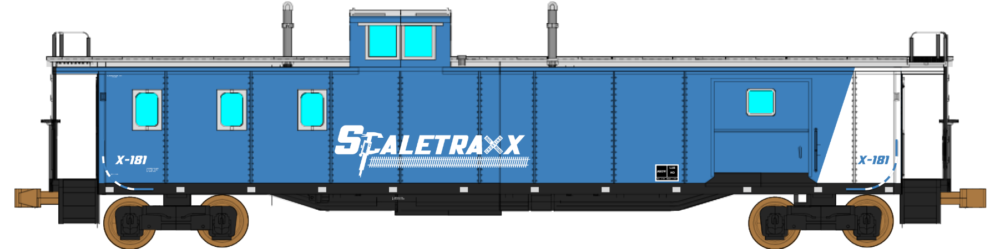


We present a brand new car to our N scale line, our 2nd longest car
Pullman-Standard 84’4″ Excess-Height Boxcars:
The Giants of High-Capacity Rail Freight
During the 1960s, North American railroads experienced a dramatic shift in freight transportation. As industries demanded larger shipments and greater efficiency, railroads began moving away from traditional 40-foot and 50-foot boxcars in favor of specialized equipment capable of carrying more cargo without increasing train length or axle loads. Among the most impressive of these designs was the Pullman-Standard 84’4″ excess-height boxcar, a massive high-cube freight car that became one of the most recognizable specialty boxcars of its era.
The prototype of this unique car was built by the Pullman-Standard Car Manufacturing Company for the Southern Railway in March 1965 as part of the 9640–9739 series. Designated as Class BS-20, these boxcars were specifically engineered to transport tobacco packed in large wooden barrels known as hogsheads. Tobacco was one of the South’s most valuable agricultural commodities, and the unusually large dimensions of the hogsheads made them difficult to transport efficiently in conventional freight equipment. Southern Railway required a car with exceptional cubic capacity rather than additional weight capacity, and Pullman-Standard answered that challenge with an innovative design that maximized interior volume while remaining within standard axle-loading limits.
At 84 feet 4 inches in length, these cars dwarfed the standard boxcars of the period. Their increased height provided an enormous interior loading space that allowed railroads to transport bulky, lightweight freight more efficiently than ever before. Unlike conventional freight cars that often “cubed out” before reaching their maximum weight, these high-cube boxcars enabled shippers to fully utilize available space without exceeding weight restrictions. This made them ideal for commodities where volume, rather than weight, was the limiting factor.
Although tobacco was their original assignment, the versatility of the BS-20 fleet soon became evident. As shipping patterns evolved and tobacco traffic declined, Southern Railway reassigned these cars to carry a wide range of commodities. Cotton, paper products, household appliances, furniture, truck tires, automotive body panels, industrial machinery, and other manufactured goods all found a place inside the spacious interiors of these remarkable boxcars. Their adaptability helped extend their service lives well beyond their original intended purpose.
The Pullman-Standard 84’4″ excess-height boxcar represented part of a broader trend toward specialized freight equipment that transformed the railroad industry during the mid-twentieth century. Railroads recognized that many customers were shipping products that occupied large amounts of space but weighed comparatively little. Building taller and longer boxcars allowed carriers to move significantly more freight in fewer cars, reducing switching costs, improving terminal efficiency, and lowering operating expenses. These innovations helped railroads remain competitive with the rapidly expanding trucking industry, which was steadily capturing freight traffic on America’s highways.
Because of their exceptional dimensions, however, these giant boxcars were not without limitations. Their increased height exceeded the clearances available on many railroad routes, requiring careful planning before they could be assigned to service.
Bridges, tunnels, overhead structures, and even signal bridges often dictated where these cars could safely operate. Many railroads marked their high-cube fleets with distinctive white stripes or bands to indicate excess-height clearance requirements, allowing train crews and yard personnel to identify them quickly. Dispatchers also relied on specialized clearance diagrams to ensure these cars remained on approved routes.
Southern Railway became the railroad most closely associated with these oversized boxcars. In addition to the BS-20 class, the railroad later rostered the BS-21 class, continuing its investment in high-capacity freight equipment. These distinctive cars became a familiar sight across Southern Railway’s extensive network, serving manufacturing centers, warehouses, and distribution facilities throughout the southeastern United States.
Following the 1982 merger that created Norfolk Southern Railway, many of the former Southern Railway high-cube boxcars continued in active freight service. Although their original tobacco assignments had long disappeared, the cars remained valuable for transporting bulky industrial freight. Rail enthusiasts affectionately referred to them as “Big Boy” boxcars due to their immense size, and they continued to stand out wherever they operated.
While Southern Railway operated the best-known fleet of Pullman-Standard 84’4″ excess-height boxcars, Pullman-Standard’s expertise in high-capacity freight car construction extended to numerous railroads across North America. Railroads such as Lehigh Valley, Maine Central, Union Pacific, and later CSX all operated Pullman-built high-capacity boxcars in various configurations. Although not every railroad owned the exact 84’4″ design, Pullman-Standard’s engineering philosophy influenced the development of high-cube freight equipment throughout the industry. Leasing programs also allowed many carriers to utilize specialized high-cube equipment without purchasing large fleets outright.
The Maine Central Railroad participated in a notable joint order of Pullman-Standard freight cars, while Lehigh Valley rostered Pullman-built equipment that reflected the growing demand for larger-capacity freight cars. These orders demonstrated the industry’s recognition that specialized equipment offered substantial economic advantages when matched to appropriate traffic.
Today, surviving examples of Pullman-Standard excess-height boxcars can be found preserved at several railroad museums, where they serve as important reminders of an era of rapid innovation in freight transportation. Museums such as the Rochester & Genesee Valley Railroad Museum and the Western Pacific Railroad Museum have preserved examples of these unique cars, allowing visitors to appreciate both their immense scale and their specialized engineering. Their preservation ensures that future generations can study one of the most distinctive freight car designs ever produced.
The Pullman-Standard 84’4″ excess-height boxcar remains an outstanding example of how railroads adapted to changing freight demands during the twentieth century. Rather than relying solely on larger locomotives or longer trains, engineers focused on increasing the efficiency of each individual freight car. The result was a fleet of specialized high-cube boxcars capable of moving more cargo with fewer cars while reducing operating costs and improving overall network performance.
Today these towering boxcars continue to fascinate railroad historians, photographers, and model railroad enthusiasts alike. Their impressive size, distinctive appearance, and important role in the evolution of modern freight transportation have earned them a lasting place in North American railroad history as some of the largest and most recognizable boxcars ever placed into regular service.
SHELL IS UNDECORATED
comes with frame and truck pins and stirrups
x2 (you get 2 cars)
Trucks and Couplers sold separately
PAINT AND DECALS NOT INCLUDED
Disclaimer Photo is of a mockup and the color of the shell you receive may change depending on what we have in stock.
Disclaimer we try to get every model done the best we can, sometimes they turn out slightly different (imperfections, slight bow) may be not 100% perfect but still pass to be a great model. Some cleanup is required (please check out the MODEL PREP page Model Prep – scaletraxx.com). We look forward to seeing our models all over, thanks for the support.
Coming soon to HO and other Scales
THANK YOU FOR YOUR SUPPORT

Reviews
There are no reviews yet.